The emergence of generative AI has sparked a global wave of “actively embracing AI.” Is generative AI an unprecedented opportunity or a potentially disruptive challenge for the SaaS industry? Will it lead to explosive business growth, or does it carry the risk of being gradually replaced by new technologies?
At last week’s Aspara Conference, an annual technology event organized by Alibaba Cloud, the CEO of Alibaba Group, CEO & Chairman of Alibaba Cloud Intelligence, Yongming Wu, stated the following, “In the past 22 months, the pace of AI development has surpassed that of any period in history, yet we are still in the early stages of the AGI revolution.” He believes that “generative AI enhances productivity by adding intelligence, thereby creating greater intrinsic value for the world. This value creation could be tenfold or even several dozen times greater than the value of mobile internet connectivity.”
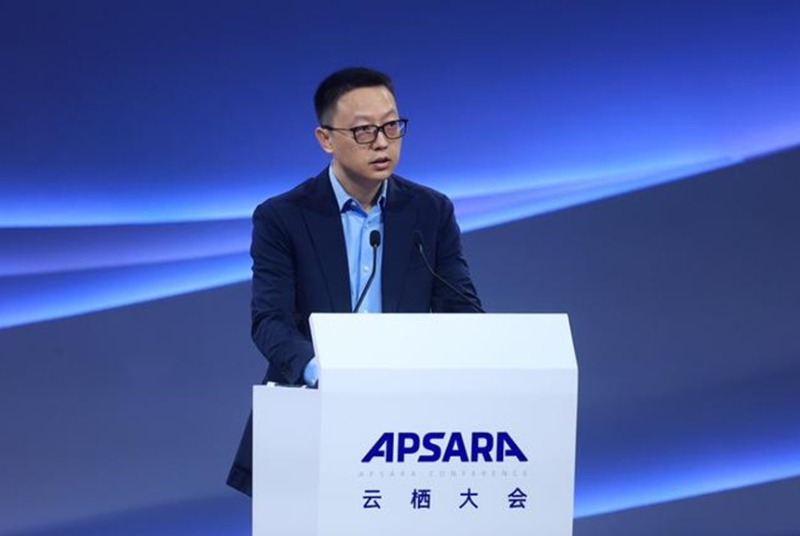
CEO of Alibaba Group, CEO & Chairman of Alibaba Cloud Intelligence, Yongming Wu
The emergence of generative AI has sparked a global wave of “actively embracing AI.” However, not all large model applications can generate commercial value. Is generative AI an unprecedented opportunity or a potentially disruptive challenge for the SaaS industry? What kind of explosive business growth can we expect, and is there a risk of being gradually replaced by new technologies? These are questions of great concern to everyone.
As described in “How Innovation Works: And Why It Flourishes in Freedom,” the steam engine was primarily used for pumping water in noble gardens for several decades after its invention until it was applied to textiles, locomotives, and steamships, at which point it unleashed tremendous value.
AI is poised to follow a comparable trajectory, potentially leading to disruptive impacts within the SaaS industry. According to Gartner’s 2024 Emerging Technology Hype Cycle, generative AI is currently in the inflated expectations phase, with enterprises shifting their focus from foundational models to use cases to enhance return on investment. To unlock genuine value, it is imperative to identify appropriate deployment scenarios for large models, bridging the gap between technology and practical application.
To seize this historic opportunity, the “SaaS Forum for Enterprises in the AI Era” was established for the first time at this year’s Aspara Conference, explicitly focusing on the SaaS sector. This forum aims to share and discuss with a wide range of SaaS companies how this essential and unique group can identify suitable business scenarios, integrate AI capabilities into their products and business processes, and transform these capabilities into integral parts of their SaaS offerings. The goal is to genuinely assist clients in solving problems and drive the reinvention and innovation of business processes.
How Next-Generation SaaS Companies Can Thrive in the AI Era.
AI presents significant opportunities and various challenges for the SaaS industry. Is AI a killer of SaaS or its savior?
At this forum, Ms. Jing Hong, the Founding Partner of Gaocheng Capital with over 10 years of experience investing in Chinese enterprise software, expressed that AI is neither a killer nor a savior of SaaS. Instead, it introduces new opportunities and challenges that can help existing SaaS companies better serve their clients. However, this will require a process, as AI must redefine business service processes from the SaaS perspective.
Applications that focus on single-point efficiency, are not embedded in workflows, and significantly overlap with significant model capabilities may be at risk of being replaced by cloud providers. However, SaaS×AI solutions deeply integrated into customer scenarios and workflows can leverage high-value industry data, gain insights into customer operations, enhance existing functionalities, and provide more innovative services to aid decision-making and actions.
On the other hand, the AI×SaaS model, built entirely on AI-native cloud technologies, delivers results directly rather than merely providing tools. This approach allows for rapid penetration into service and operational markets, presenting substantial commercial potential.
Technological innovations represented by AI are the fundamental driving force behind societal progress, but the actual value lies in the widespread application of these technologies. Each technological cycle has spurred management and business innovation while unlocking new demands, from the steam engine to the computer and the internet. In many overseas sectors, such as marketing and product development, the demand for SaaS applications is rapidly increasing, and there are heightened expectations for the commercial potential of generative AI. However, we are still in the phase of inflated expectations. We can achieve a mutually beneficial development between AI and SaaS through continuous application and market validation.
The Chinese market has unique characteristics, including computing power limitations, compliance pressures, differences in enterprises’ willingness to pay, and data security concerns. It faces a “four-in-one” effect (digitalization, cloudification, mobility, and artificial intelligence), which presents opportunities and challenges. For SaaS companies to succeed, they should focus on specific niches and customers, avoiding overly broad product concepts. Starting with smaller markets and gradually expanding through a Minimum Viable Product (MVP) for market validation can help create measurable value. Collaborating with large model and cloud service providers throughout this process is essential to explore technological innovation, fostering a win-win partnership.
The three elements and three stages of “SaaS×AI.”
Since the advent of significant model technology, Alibaba Cloud, one of China’s leading cloud computing and AI technology service providers, has engaged in deep technical and business exchanges with its enterprise SaaS partners based on its cloud computing and significant model technology. This process has also explored and summarized the three elements and stages for SaaS companies using significant model technology.
At this forum, Fei Gao, Vice President of Alibaba Cloud Intelligent Group and General Manager of the Public Cloud North China Region, summarized three key elements that SaaS companies should consider when using large model technology:
1. Selection of Base Model: It’s crucial to choose a large model with parameter capabilities suitable for the SaaS enterprise. Additionally, considerations should include engineering capabilities such as text generation, instruction following, code generation, and workflow orchestration.
2. Agent Toolchain: Alongside model selection, the toolchain’s capabilities are essential. A rich toolchain can significantly enhance development efficiency for SaaS companies, including tools like Prompt Engineering, SFT (Supervised Fine-Tuning), CPT (Contrastive Prompting), and Memory.
3. Inference Computing Capability: Inference computing capabilities must also be considered beyond the model’s capabilities and the richness of the toolchain. This includes the elastic scaling of inference platforms, elastic scheduling, global computing power distribution, and nearby access for inference, which together enable a robust model ecosystem supply capability.
These elements provide valuable guidance for SaaS companies leveraging extensive model technology effectively.
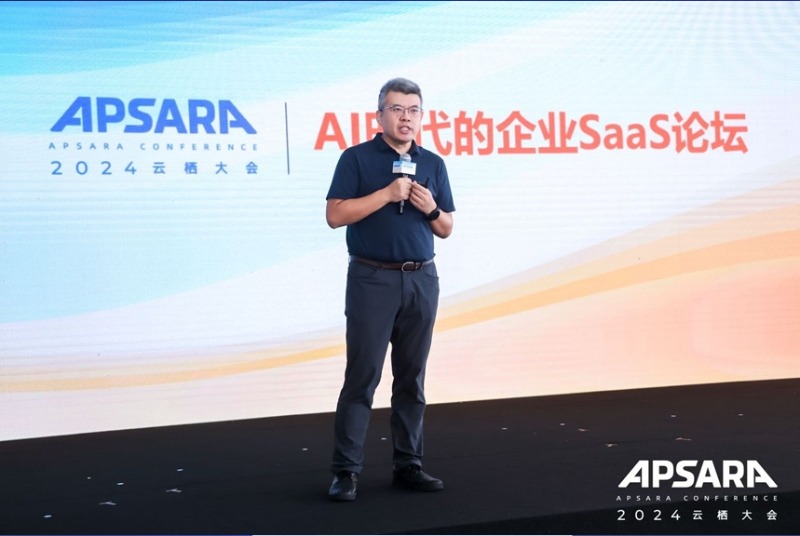
Vice President of Alibaba Cloud Intelligent Group and
General Manager of the Public Cloud North China Region, Fei Gao
Tianjian Zhang, General Manager of Alibaba Cloud Intelligent Group’s Large Model and AI Computing Solutions, has observed three stages that enterprises experience when applying large model technology to SaaS products and transforming it into productivity over the past year while collaborating with numerous SaaS companies:
1. Interaction Upgrade: AI super assistants become the core interactive interface for enterprise IT.
2. Process Reengineering: This stage goes beyond optimizing business processes; it involves redesigning and reconstructing service workflows through AI.
3. Digital Employees: Future SaaS products will be embodied as “digital employees,” with AI representing the ultimate form of enterprise productivity.
These stages highlight the transformative potential of integrating AI and large model technology into SaaS solutions.
Today, the ultimate goal for enterprise SaaS is the digital employee, as AI has become an essential part of business productivity. Alibaba Cloud officially launched AI001, Tongyi Lingma, an intelligent coding assistant tool three months ago. Alibaba Cloud awarded Lingma an employee badge because its code adoption rate has surpassed 30% across the Alibaba Group and many of its clients. This means that 30% of the code written by programmers in the Alibaba Group is generated by Lingma rather than being manually written. Programmers need to copy and paste this generated code. Therefore, we firmly believe this tool is integral to our productivity.
Today, using AI in coding is just the beginning of productivity development. As model accuracy and the maturity of surrounding engineering improve, we will see the emergence of various digital employees across all aspects of a business, from human resources and finance to supply chain, production, and sales. This expansion will transform numerous specialized areas within enterprises, enhancing overall efficiency and productivity.
Building high-quality AI applications that customers are willing to pay for still presents significant technical challenges. A model-centric development paradigm is key to embracing this trend. In response to these challenges, Alibaba Cloud is committed to continuously lowering technological barriers by offering advanced cloud and AI services. At the same time, it adheres to its ecosystem positioning, collaborating with partners to drive the arrival of the AI era together.
At this year’s Cloud Habitat Conference, Alibaba announced its full commitment to upgrading its AI infrastructure. The base models have also been upgraded, achieving performance comparable to GPT-4o, and the most powerful open-source model, the Qwen 2.5 series, was released. By continuously upgrading AI infrastructure and base models, Alibaba aims to unleash technological dividends, providing more robust support for SaaS companies to thrive in the AI era.
“SaaS×AI”: Pioneers Lead the Way.
In the competition of “SaaS×AI,” some SaaS “pioneers” have seized this historic opportunity and actively embraced transformation. They have combined their industry expertise with big model technology, leveraging AI to create a first-mover advantage in business reconstruction and innovation. Alibaba Cloud invited several outstanding companies to share their practical experiences during this conference.
Among many SaaS companies, Beijing Qianlima Internet Technology Co., Ltd. was among the first to apply large model capabilities to SaaS services. To help businesses navigate complex bidding processes, Qianlima launched the “Haima Bidding Document” AI writing platform. This professional document generation software is based on hundreds of millions of bidding data and a wealth of high-quality bidding documents, integrating tools for a deep understanding of tender documents, intelligent generation of bidding proposals, document formatting, and knowledge management.
“Introducing large models has made automated document generation possible,” said Qianlima’s Chief Strategy Officer, Yonghua Luo, at the conference. With the support of Tongyi Qianwen and Alibaba Cloud’s computing power, Haima Bidding Document effectively addresses the challenges of automatically generating high-quality bidding documents, particularly regarding compliance, accuracy, and efficiency in the document creation.
Beijing Sinoiov Information Technology (SINOIOV) is the country’s leading logistics technology and service platform. Leveraging cutting-edge technologies such as AI, IoT, and big data, the company has developed a commercial vehicle IoT platform to empower the logistics ecosystem and create digital, intelligent solutions that simplify logistics operations. Their Zhongjiao AI Card, an intelligent data analysis tool, provides efficient data analysis and decision support for commercial vehicle manufacturers. Using natural language queries helps users easily access the data and analyze the desired results. Chen Liling, General Manager of SINOIOV’s Data Center, stated that the Zhongjiao AI Card relies on Alibaba Cloud’s PolarDB for AI, utilizing intelligent algorithms and a big data platform to support digital marketing and analysis for commercial vehicles.
At the conference, SINOIOV partnered with Beijing Trucks to launch a new product, the “Zhongjiao AI Card Heavy Truck Large Model,” which leverages Alibaba Cloud’s PolarDB for AI and the Tongyi Bailian platform.
Beijing Xiruiya Technology, focused on the HR SaaS sector, is dedicated to integrating AI technology into recruitment, organizational management, and performance management modules. As early as 2018, Moka established an AI team and launched its AI-native product, Moka Eva, in 2023. By integrating AI technology, this product enhances HR efficiency and decision-making quality.
With AI’s reasoning and generalization capabilities, interviewers can better assess candidates, improving recruitment efficiency and quality. Hongze Liu, Moka’s partner and CTO, highlighted features like the intelligent meeting summary function, automatically recording and summarizing conversations during interviews, and providing detailed feedback. This effectively addresses the challenges of recording and tracking interviews.
Moka leverages Alibaba Cloud to advance the exploration and application of AI technology in the HR SaaS field, achieving notable results, especially in cost optimization.
Cloud computing opens up new growth curves for SaaS.
Undoubtedly, AI’s disruptive impact on the SaaS industry will continue to amplify. However, in this process, cloud computing serves as a vital engine for developing enterprise SaaS.
Liwei Chen, General Manager of Solutions for Alibaba Cloud Intelligent Group’s Public Cloud North China Region, emphasized during his presentation that “multi-tenancy across all dimensions is the core competitiveness of SaaS.” In today’s context, “multi-tenancy” refers to “multi-tenancy across all dimensions,” which encompasses significant advancements in security, availability, performance capacity, and even cost measurement and billing methods.
Alibaba Cloud provides corresponding solutions on both computing power and data fronts. In terms of computing power, the full-link Serverless architecture reduces operational and cost pressures, enhancing the elasticity and performance of SaaS products, especially in multi-tenancy isolation and rapid scaling. On the data side, cloud-native databases and big data products effectively facilitate data isolation, elastic demand, and agile business responses while reducing the operational complexity for DBAs. In the future, SaaS companies must upgrade their development tech stacks by integrating AI technology into their products to enhance product capabilities, support intelligent decision-making, and optimize business operations.
As a leader in the SaaS industry, Yonyou Group is also at the forefront of AI applications. Since 2015, Yonyou has collaborated with Alibaba Cloud, leveraging its database and cloud technology platform. Together, they utilize various cloud service models—including public, private, and dedicated clouds—to assist different types of enterprises in achieving digital transformation. Yonyou has also adopted cloud-native technologies like Serverless and big data processing to enable elastic scaling of business operations and efficient management. Guanjun Fang, CTO of Yonyou Network Technology Co., Ltd., mentioned that with the support of AI, Yonyou BIP can better understand human language and facilitate communication through natural language.
The Yonyou YonGPT large model integrates foundational models like Tongyi Qianwen to help enterprises achieve intelligent business operations, natural human-machine interaction, smart knowledge generation, and semantic application generation, moving toward intelligent operations. Additionally, both parties have jointly developed industry data solutions with an HTAP (Hybrid Transactional/Analytical Processing) architecture, allowing shared storage for transaction processing (TP) and analytical processing (AP) along with real-time, efficient data processing. This supports enterprises’ OLTP (Online Transaction Processing) and data analysis needs, enabling SaaS-based database clusters and integrated deployment of BIP services.
Qmai Technology is focused on rapidly establishing overseas operations for retail enterprises by connecting online and offline channels, helping stores achieve full-link digital upgrades. Quan Liu, Partner and CTO of Qmai Technology, highlighted that key challenges faced by all companies expanding internationally include showcasing product competitiveness, quickly adapting to local cultural practices and regulatory requirements, and managing the delivery, implementation, and operations costs. In overseas markets, SaaS products must significantly outperform existing local systems, providing a simpler and more efficient user experience. Qmai Technology has assisted clients like Jollibee in replacing outdated POS systems, delivering a more lightweight and user-friendly product experience. Alibaba Cloud consistently adheres to the vision of “a global network, a cloud, and a unified strategy,” providing strong support for Chinese SaaS enterprises going abroad. In future international endeavors, with the backing of Alibaba Cloud, Qmai Technology can focus on front-end digital operations and data services without overly concerning themselves with underlying infrastructure, thereby offering more efficient services across regions and countries.
ZhiChi Technology, dedicated to becoming a global provider of customer contact center solutions, is also actively developing its overseas business. The company began its international expansion four years ago, responding passively to customer demands. Three years ago, it started to explore opportunities proactively, and now, going abroad has become a primary strategy for the company. Through its collaboration with Alibaba Cloud, ZhiChi Technology has significantly reduced business deployment time by leveraging its mature cloud infrastructure. The partnership allows flexible scaling and disaster recovery to handle sudden traffic spikes while providing robust security protection and operational tools. This enables ZhiChi Technology to focus on the development of its core business. In application technology and artificial intelligence, ZhiChi Technology has leveraged Alibaba Cloud’s global edge nodes to establish a cloud call center that spans the globe, reducing network latency and enhancing customer experience while ensuring data compliance. The application of AI plays a crucial role in customer service scenarios, particularly in email processing, online chatting, and voice interactions. AI improves efficiency by addressing issues like email classification and spam filtering, thereby reducing the workload for customer service representatives. ZhiChi Technology’s Director of Internationalization Consulting, Xinlong Duan, stated that by integrating Tongyi Qianwen, the company has optimized intelligent interactions and AI Agent capabilities in customer service scenarios.
In the future, Alibaba Cloud will further assist SaaS companies in better responding to market changes and expanding new growth curves through its full-link Serverless solutions, cloud-native databases, big data platforms, and global capabilities, ultimately achieving business success.
AI empowers SaaS, exploring a new chapter of transformation.
As the wave of AI sweeps across the globe, SaaS companies find themselves at the forefront of this transformation. The challenge for all SaaS enterprises is genuinely integrating AI technology into their business scenarios, moving from merely “tasting” it to effectively “quenching” their needs. Mr. Demos Guo, Managing Director of Gaocheng Capital, served as the moderator for a roundtable discussion featuring key figures such as Yi Zhang, AI Head at Schneider Electric (China); Hao Sun, General Manager and CIO of Mingming Hen Mang Group’s Digital Center; Wei Li, Vice President of Business Development at Suzhou Gaiaworks; Fangchao Sun, Senior Vice President of Beijing Minglamp Technology; and Baochan Wang, Founder and CEO of Beijing Yiyuan Cool Technology Co., Ltd. They engaged in an in-depth discussion on SaaS’s practices, implementation, and future outlook in the AI era.
AI practices show that SaaS companies must be bold in embracing new technologies. The emergence of AIGC has opened up new possibilities for SaaS companies to enhance product performance and optimize user experience by integrating user scenarios. By fully leveraging Alibaba Cloud and the capabilities of large AI models, SaaS companies can incorporate these technologies into various aspects of enterprise services, including design, marketing, data analysis, employee time management, product management, inventory, and store standardization. Furthermore, these technologies can also contribute to helping businesses achieve carbon reduction and emissions goals.
SaaS companies still face many new challenges in the implementation of AI. It includes the challenges of technology selection and demand matching, data quality, balancing investment and returns, and issues related to data security, algorithmic bias, and privacy protection. The guests agreed that successful AI implementation requires attention to the technology, user experience, cost-effectiveness, and ecosystem collaboration. When selecting AI solutions, companies should consider their unique business characteristics to choose the most suitable models and deployment methods. Additionally, the entire industry must strengthen cooperation to build a healthy and sustainable AI ecosystem.
“People tend to overestimate the impact of new technologies in the next two years while underestimating their impact over the next decade.” The confidence of SaaS companies in maintaining a long-term perspective on the future development of AI remains strong. The participants agreed that AI technology will evolve towards greater intelligence and humanization, enhancing user experience and enabling users to interact more naturally with AI to complete complex tasks collaboratively. AI technology is expected to increase the efficiency and value of SaaS products, becoming a powerful tool for improving productivity and reducing labor costs.